VINEYARD DEVELOPMENT
By: Pete Anderson


I. Planning
A. Decision to develop a vineyard should be based on an in depth study of several factors which will entail incurring an expense prior to the work at the vineyard site or purchase of materials. This phase will take place at least one year prior to planting.

1. The type of development, commercial enterprise or home vineyard operation, will determine the scope of the project, but, either should have the production of a quality wine grape as the key objective.

2. Available financial resources will determine the size and timeline of the development. The commercial enterprise will anticipate a profit return on its investment either from the sale of the product or from the increased evaluation of the property upon which the vineyard is developed. The commercial enterprise will also have to be prepared to fund the development for around three years before any income is received. The home vineyard will derive a more immediate reward from the sense of accomplishment of growing a vine that produces a berry worthy of making a drinkable wine; it also will provide an esthetic reward of watching a vineyard mature plus adding to the value of the property.

B. Market research should be a primary step for the commercial enterprise. Study of market trends published by such groups like Allied Grape Growers and publications such as Wine Business Monthly will help decide what the target market will be: production of wine grapes and/or wine. The income derived from a ton of grapes ($1500) compared to the income from the sale of a bottle of wine ($10) made from that same ton of grapes (1 ton grapes = approximately 180 gallons = three 60 gallon barrels = 72 cases = 864 750 ml bottles) which would produce income of almost $9,000. The question then would be do you become a vine grower or wine grower.

C. Either operation should make use of college level viticulture / enological courses, publications, web sites, etc. covering all aspects of the trade to assist in the strategic decision making. If the developers do not educate themselves, they should be prepared to hire consultants to provide the professional knowledge needed to make wise decisions.

D. The above research and fact finding should set the guideline for what type of vineyard development plan will be executed and to include the selection of the wine grape varietal(s).

II. Vineyard Site
A. Selection can now proceed taking into consideration the decisions made in the above planning phase The site selection should involve the following considerations and steps:


1. Location - the site location will be limited somewhat by the varietal(s) selected; e.g., it would
not be practical to select a heat summation region IV location to grow a grape that requires
conditions found in a region I (much cooler temperatures).

2. Evaluate and assess the soil, pathogens, nematodes, microclimate. Soil analysis can be
made by labs such as California Growers Lab for $75 each sample. Pathogens and nematodes
will require separate testing procedures available through specific labs. Review climate records
for the last five years to get an average reading of monthly temperatures, precipitation,
humidity, sunshine, marine layer, etc.

3. Evaluate irrigation requirements, water supply and quality. If vineyard site is not supplied
by district water company, obtain natural water assays for both present and future supply and
quality to include well drilling depth. Obtain water district regulations on agriculture and
future plans.

4. Local and regional codes, restrictions and future development plans. Check with local and
land use, environmental and agricultural codes etc. to include winery/tasting room
permits

5. Labor resources - determine if seasonal labor force available to perform vineyard work


B. Plant material

1. Rootstock selection can be made after the vineyard site evaluations and assessments
have been completed and the site has been selected.

2. Dormant grafted vines can now be ordered for following Spring delivery. The vineyard
spacing (and plantable acreage) will determine the number of vines to be ordered. Cost
per vine is usually dependent on number of vines ordered and can be $2.50 - $3.50 each.


C. Site Preparation - each site will differ in cost per acre but can reach several tens of thousan dollars depending on site preparation and number of vines

1. Clearing and ripping planting site

2. Fumigation (Vapam etc.) if required for nematode control. The fumigation only lasts for a
year or two and will still require consideration of nematode resistant rootstocks

3. Soil amendments based upon lab soil analysis

4. Layout based on spacing of vine/row (number of vines equals 43560 sq ft (1 acre)
divided by (distance between vine times distance between row ) Spacing will also depend on
whether manual or mechanical labor will be used to manage the vineyard. If manual
labor is not a dependable resource, site layout will require mechanical equipment which will
be a major budget item

5. Trellis system - this will be dependent upon varietal selection, microclimate factors and
whether manual or mechanical management. The end posts, inter-row stakes, irrigation wire
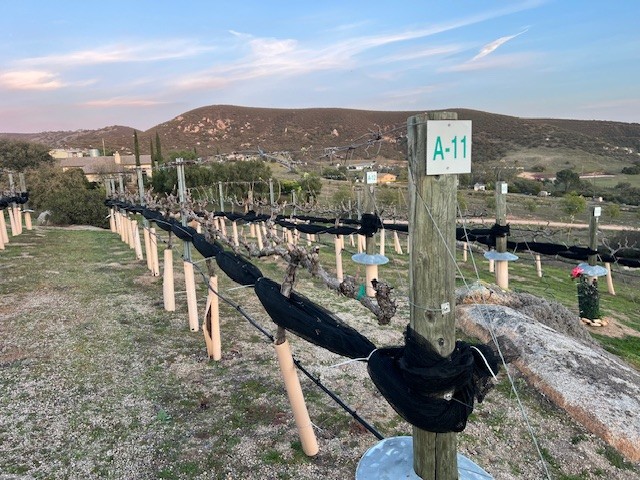
and cordon wire should be installed before planting. The vine stakes and grow tubes can be
purchased prior to the planting of the vines. Catch wires can be ordered and
installed early in the second year since the first year vine growth usually will not require it.

6. Irrigation installation - this should take into consideration soil, topography, microclimate
and should consider zone valve controls and pressure compensating emitters.

III. Vineyard Management


A. Cultural practices that are perennial and cause seasonal labor demand spikes

1. Dormancy (Winter) - Pruning is the main activity; planting of cover crops if required,
spraying of vines after pruning for pest (insect, fungicide, etc) control

2. Bud break - Shoot Growth (Spring) - Shoot removal and positioning. scheduled pest
control spraying , weed control, tip pruning if desired for better berry set

3. Veraison (Summer) - Green pruning, de-leafing, install netting or other bird protection,
scheduled spraying, fruit dropping if necessary

4. Harvest (Late Summer Early Fall) - grape harvest, remove netting, pest control spray
(Kocide or other treatment for control of over wintering fungus), soil amendment if needed


B. Labor Force - if manual labor supply is available, but not experienced in viticulture,
consideration should be given to retaining a core crew on a permanent basis to avoid retraining
costs and costly performance mistakes.

C. Calendar & Budget Items

1. Year 1 - fumigation and soil amendments as needed, installation of vineyard hardware to
include everything except cross arms and catch wires, irrigation system ( preferably all prior
to planting of vines), vine planting to include stakes and grow tubes. Monitor and control for
signs of pests and fungus. Select trunk cane to include removing lower laterals and tipping to
encourage upper lateral growth for cordon selection . Weed control. Remove grow tubes
unless signs of rodents in which case leave until leaf senescence. Costs will be the price of
fumigation and amendment materials and their application, price of vineyard hardware and
their installation, final payment for plant material if only down payment made at time of order,
grape stakes and grow tubes. Cost of labor to perform all of the above actions.

2. Year 2 - complete trellis hardware (cross arms, catch wires), inspect all vines for growth
(prune cordons back to crown of trunk if not at least pencil size; prune trunk back to two
nodes above graft union if trunk is not pencil size) , perform all cultural practices (pest and
fungal control, weed control) train vines onto cordon, remove new fruit if root development
required, position canes, replacement of vines that did not grow.
Costs will be price of remaining trellis hardware and installation, cost of new vines, cost of
pest control materials and application. Cost of Labor to perform above actions.

3. Year 3 - this will be the start of the Vineyard Management Cultural Practices cited above.
This will be the first harvest which will have a reduced crop and uncertain quality, but
a possible source of income.
Costs will be mainly Labor to perform all of these Cultural Practice actions. New items
could involve petiole analysis to determine nutrient uptake of vines, foliar spray
materials to correct deficiencies and bird netting or another protective device.
Harvest Labor cost will increase in Years 4 and 5 and then level off. Income will also
increase in subsequent years commensurate with the level of allowed production and market
prices.