PRUNING
by
Pete Anderson


HISTORY: The earliest record of pruning grape vines is pictorial and appears on the wall of an Egyptian tomb (circa. 2440 B.C.) When the Greeks arrived in Italy they named the land, Oenotria, the land of the vine, and found a pruning and canopy system referred to as Alberello (translated as bush). This system is popular with the Zinfandel old vine vineyards in California. A written account appears in the writing of Pliny The Elder, "Historia Naturalis", in A.D. 77 and a detailed description of caring for the vine (viticulture) is written in "De Re Rustica" by Calumella in the 1st Century A.D. The Etruscans, early inhabitants of Italy, improved the system and used live-growing trees (ALBERATA) to form the trellis system for the vine and trained the vines up these trees. There are places in Italy today that still use this system; e.g., Caserta and Napoli where you can see the Asprinia grape growing 40 plus feet high on Poplar trees. I had the experience of picking these white grapes by using a 40 foot ladder which is 1 foot wide and the rungs are approximately 2+ feet apart ( you place the instep of one foot on the rung above and one on the rung below and hook your knees under the rung above each foot) - surprisingly, it provides a great deal of mobility to swerve from one side to the other as you go up the ladder and pick the grapes to each side. (Can't say the wine was as stellar as the experience - it makes great vinegar in most years!) The Romans improved on the two above systems by developing a Vertical Shoot Position trellis. There was no further change of the vineyard canopy system until the 1800's when Dr. Jules Guyot developed the Guyot cane pruned system. Since then, there have been many new systems to improve the vineyard side of winegrowing; e.g., Dr Shaulis at Cornell University Geneva Double Curtain .

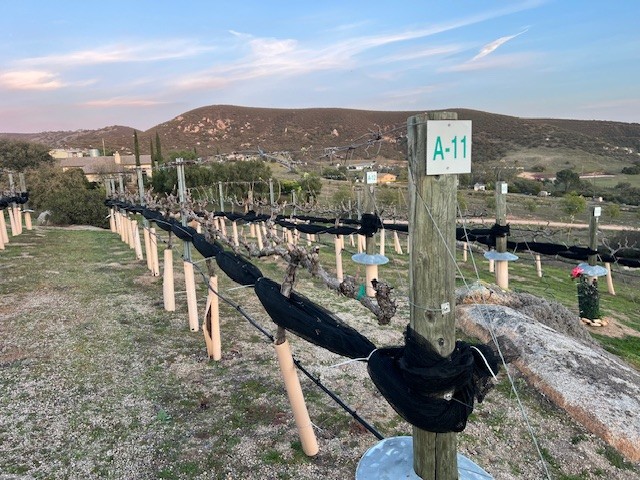
WHAT: Pruning, in its most simple form, is the removal of vegetative growth either of the previous season's growth or the current season. It is a significant part of Canopy Management.

WHY: I believe a famous inventor from Florence, Italy, Galileo, gave the most compelling reason: "IL VINO E UN COMPOSTO DI UMORE E DI LUCE" ("Wine is sunlight held together by water")

Major benefits and objectives:

- CONTROLS SIZE & FORM OF VINE
- OPTIMIZE PRODUCTION POTENTIAL
- MAINTAIN BALANCE OF GROWTH/FRUIT
- DELAY BUDBURST
- REMOVE DISEASE

WHEN: There are two general periods when pruning takes place:

DORMANCY: This is the period between leaf senescence and budburst. It is easy to identify this time by making test pruning cuts to see if the translocation of carbohydrates have finished - no fluid is detected flowing out of the cut.

SUMMER: This is when the current season's vegetative growth has reached such an abundance that the vegetation has become the predominant sink and is depriving the fruit of needed nutrients for proper ripening. There could be removal of vegetative growth (de-leafing) earlier in the growing season if there is a possibility of disease, such as powdery mildew.

TYPES: There are two basic.

CANE (Guyot, Cordon du Royat) - this system calls for the fruiting arm (cordon) to be replaced each year.

SPUR (Single/Double Cordon, Head) - this system retains the main cordon coming off the crown of the trunk, but renews the fruiting shoot at each spur.


HOW: There are several factors that should be considered before taking any pruning action:

- SCION CHARACTERISTICS - some grape varietals have a primary bud or low basal fertility problem. For instance Syrah can have a primary bud failure which will then depend upon either the secondary or tertiary buds (a grape vine node usually consists of three buds) to produce a fertile shoot. This does not always occur. Nebbiolo has an even more dramatic issue in that the first 2 or 3 nodes of the shoot can be infertile - this means that if you were two-node spur pruning your vine and had left a five spur cordon , there is a good possibility that only two spurs of that cordon would produce fruit. NEBBIOLO REQUIRES CANE PRUNING to be best productive. An ounce of prevention is worth a pound of cure saying applies here: choosing the right rootstock for the varietal scion is crucial. For example, Sangiovese is listed as a high Vigor vine - you should not graft this onto a 1103P rootstock which is also high Vigor or no amount of pruning is going to make your vineyard life very rewarding!

- FRUIT YIELD TO PRUNING WOOD ( Y/P) RATIO - Dr. Richard Smart (who we had the opportunity to have as a guest speaker at a previous meeting) offers the Golden Rules of pruning in his book, "Sunlight Into Wine" wherein he lists the Y/P ratio of 5:10 as optimal and pruning weigh of .3 - .6 kilogram per meter of vine as optimal. He suggests that if the pruning weight exceeds 1 kilogram per meter there should be consideration of canopy change.
There are various Balance Formula which can range from high vigor vines: 30 + 10 or low vigor vines: 20 + 10. Basically, this means that for each first pound of pruning wood weight leave the first number (30 or 20) nodes at pruning to balance the vine and for each subsequent pound of pruning wood weight leave an addition 10 nodes.

- PRUNING CUT - it is best to make a 45 degree cut so that the sap (if any) flows away from the node below the cut; also the cut should be about ½ inch above the last node. If it is at the end of a cane and you want to tie the cane to the wire make the cut thru the node so that there is a flange which will keep the tie from fall of the end of the cane.

- INTERNODE SPACING - if using the spur pruned method, allow for 3 -4 inches between each spur on the cordon (usually I just grasp the cordon with one hand and use that as the measurement).

- CANE PRUNING - when selecting the new fruiting cane make sure it is round, not flat; it should be at least ¼ inch diameter at the 5th or 6th node; you can either place the cane along the cordon wire and tie it at the end, or, you can grasp the cane with both hands and bend the cane at the internode spaces which will allow you to wrap the cane around the wire without causing damage to the cane or using a tie-on.

- REPLACEMENT SPUR - if the spur on the cordon become too long, you can choose a two year-old sucker cane on the cordon to be the new spur and prune off the older spur.

- KICKER CANE (aka: sacrificial cane) - if you are having trouble controlling the vigor in your vineyard, it is possible to delay budburst and depress vigor by leaving a full-length cane either at the end of the cordon or at the crown of the trunk in the cane pruned system. This cane will become a sink for the new growth and minimize the growth of the remainder of the vine. It can be removed after bloom.

VINE PRUNING REMINDER: whatever pruning action you take this year will be reflected in next year's growth and production.

REFERENCES

There are numerous reference books and websites; however, I have found the following to be most instructive:

A. J. Winkler et al. General Viticulture, The Regents of the University of California 1974

B.G. Coombe and P.R. Dry Viticulture Volume 2 Practices, Winetitles Adelaide 1992

R. Smart and M Robinson Sunlight Into Wine Winetitles Adelaide 1991

Wes Hagen Pruning Tips: Backyard Vines, Winemaker Magazine Winter 2000

www.grapeandwine.com.au/may02/07.htm# Kym Ludvigsen Pruning: Training and Trellising

http://viticulture.hort.iastate.edu/info/pdf/prunecanopy.pdf this is a very illustrative site that altho it pertains to grape growing of mainly American hybrids, it is very instructive