Location
Grapevines are not very fussy. They can be successfully grown in sandy soils,
clay soils and rocky soils. Vines do require full sun exposure, so they will
not do well in a shady spot. In addition to full sun, vines don't like wet feet,
so well drained soils are needed.
How Big
Crop size depends on the grape variety, weather, soil conditions, vine density,
water, etc. One to two tons per acre is usual for old, dry farmed vineyards
planted in the cool coastal regions of California. Fruit from old vines often
display concentrated flavors, and the intense flavors carry over into the wine.
On the other hand, heavily fertilized and irrigated vineyards in the Central
Valley often produce 12 or more tons per acre. Fruit quality suffers when production
is so high, and such large crops often result in wine with poor color, low acidity
and weak flavors.
In large well-managed vineyards, yields of 3 or 4 tons of grapes per acre can
be expected for quality grape varieties. If an acre contains 600 vines (a reasonable
number) and produces four tons of fruit, each vine is producing about 13 pounds
of grapes. Thirteen pounds of grapes will make about a gallon of wine, so a
gallon of wine per vines is often used as a rough estimate. But, such yields
may be too optimistic for small vineyards. Small, isolated vineyards are more
difficult to manage successfully, and they are much more susceptible to deer,
coyote, rabbit, bird, and bee and wasp damage.
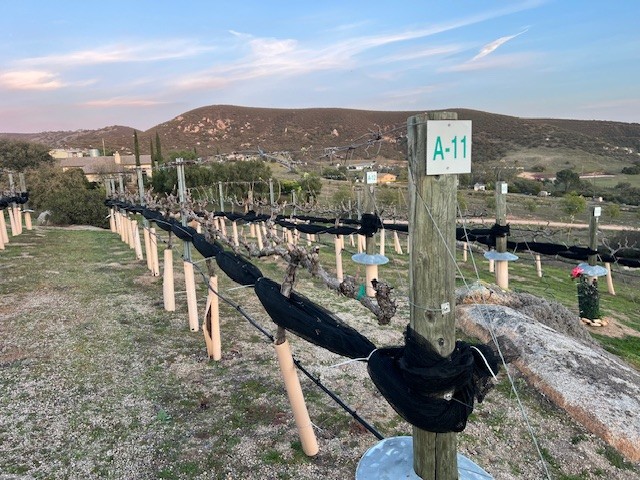
Vineyard Layout
Fifty years ago, vineyard rows were often 12 feet apart, and the vines were
spaced 8 to 10 feet apart in the rows. Many old Cucamonga vineyards were spaced
12 feet by 12 feet and only contained about 275 vines per acre. Most of these
vineyards were dry farmed, and the wide spacing and free standing vines allowed
the vineyards to be cross cultivated to remove the weeds and conserved the available
water. In recent years, the trend has been to plant closer spaced vines. Today,
new vineyards are being planted with rows spaced from 7 to 10 feet apart, and
the vines are spaced 4 to 8 feet apart in the rows. The closer vine spacing
results in 600 to 1200 vines per acre, and when adequate trellises are used,
the greater vine density can result in larger crops and higher quality fruit.
Irrigation
Depending on growing condition, vines require 20 or more inches of water per
year. (One inch of rain covering an acre is called an acre-inch and contains
about 27,500 gallons). For normal spacing, vines occupy the space available,
so the annual water required per vine depends on the number of vines per acre.
Vineyards with normal vine spacing and in warm locations may require 500 or
so gallons of water per vine per year.
The average rainfall in San Diego is only about 10 inches per year, and crop
size will be very low or even nonexistent without supplemental water. Since
less than half the needed water is supplied by rainfall, an additional 10 to
20 inches of water will be needed in most locations. Most local vineyards are
irrigated with drip systems because water is expensive in San Diego County.
Most of the water is lost through the leaves, so the amount of water used by
vines depends primarily on the size of the canopy and the ambient temperature.
Water requirements are very low when vines are dormant, and water demand is
highest in July and August when the canopies are large and the ambient temperature
is high. The water needed by vines varies greatly with growing conditions, so
judging how much water a new vineyard may require is difficult.
Planting Costs
Contractors charge from $15,000 to $35,000 per acre to plant new vineyards on
clear land. These costs include land preparation, an irrigation system, a trellis
system and planting with grafted cuttings. Costs can be even higher when new
vineyards require extensive grading, drilling wells, etc. Home winemakers often
plant their own vineyards, and the savings can be significant since much of
the overall cost is labor. The cost of materials for a simple 2-wine trellis
and a drip irrigation system can range from $2,000 to $5000 per acre. Sometimes,
second hand materials for an irrigation system or a trellis can be found, and
the savings can be considerable. Grafted vines cost from four to six dollars
when purchased in small quantities. But, Phylloxera is not a problem in San
Diego County, so vines can be successfully grown on their own roots from cuttings.
Cuttings are easier to plant than rooted stock, and cuttings can often be obtained
for little or nothing at pruning time.
Upkeep
Even small vineyards require a significant amount of labor each season. Weeds
must be controlled by cultivation or by spraying with a herbicide each spring.
Most local vineyards must be sprayed or dusted from 2 to 8 times each year to
control powdery mildew and some locations require additional spray applications
to control insect pests. Vines must be pruned each winter, and most amateurs
can only prune 200 vines or so per day, so several days may be needed to prune
an acre. Grapes must be picked promptly when they become ripe. Picking is hot,
dirty work, and under good conditions, most amateurs will pick a few hundred
pounds per day. Picking is much slower when grapes must be carried long distances
out of the vineyard, or when the bees and wasps are troublesome.
Summary
Many home winemakers plant their own vineyard because buying high quality grapes
is difficult. However, considerable time and labor are needed to grow good grapes.
In addition, little crop is produced the first two years, and four years are
often needed to produce a full crop.