PRE HARVEST SUGAR
SAMPLING
by
Lum Eisenman
Predicting harvest time is difficult, so winemakers and growers go into their
vineyards and start taking "sugar" samples several weeks before the
expected harvest time. New samples are then taken every few days and the data
is often plotted in graphical form.
Variations are Large
Depending on weather conditions, bloom can extend over many days. Later in the
season, clusters from early blooming flowers are more mature and contain more
sugar than clusters from late blooming flowers. Differences of several Brix
can occur from cluster to cluster, and these differences make sugar testing
difficult. Grapes from a single cluster contain different amounts of sugar.
In general, grapes high on the cluster contain more sugar than grapes taken
from the bottom of the cluster. Grapes taken from clusters receiving the most
sun tend to contain the most sugar, and grapes taken from clusters growing back
under the foliage contain less sugar. There can be significant differences in
the sugar content of grapes from vines growing in different parts of a vineyard.
These vine to vine variations depend upon soil conditions, water application,
sun orientation, wind and many other factors. A two Brix variation over a five
acre vineyard block is often seen.
Large Sample Needed
A large number of grapes must be sampled in order to obtain reasonably accurate
results because of these large variations. A sample consisting of 100 individual
berries is considered the minimum size sample for a small vineyard. Large operations
often collect 500 to 1000 berry samples. Most winemakers consider a few hundred
berries to be an adequate sample size. Uniform Collection Necessary Collecting
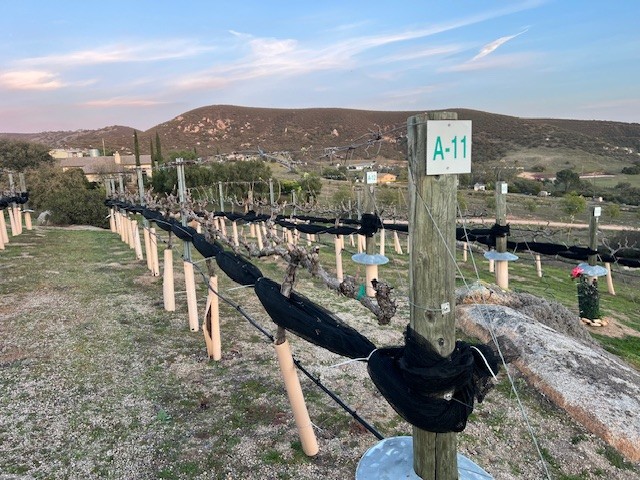
sample grapes in a consistent way and from all parts of the vineyard is important
for accurate results. For example, a large and uniform sampling of the entire
vineyard would be collected if two grapes were picked from each vine in a vineyard
containing 100 vines. Alternatively, taking one grape from every fourth vine
would produce a uniform sample of 250 grapes in a vineyard containing 1000 vines.
The most important consideration is to attempt to collect a reasonably large
sized sample from the entire block that will be picked.
Collection Procedure
The following procedure has produced good results in the past, but any collection
method that meets the above objectives should produce satisfactory results.
1. Use a 1 quart size, heavy weight, zip-seal, baggy to hold the sample grapes.
2. Pick one or two grapes from each vine (or every other vine or every 5th,
etc.) in order to collect 100 to 300 grapes. Be sure to sample the entire vineyard
block in a uniform way.
3. Pick the sample berries from the bottom of the grape clusters (watch out
for bees).
4. Pick the sample grapes from clusters that are growing under the canopy in
the shade.
5. When finished, seal the baggy and keep it cool until the measurements are
made.
Sugar Measuring Instruments
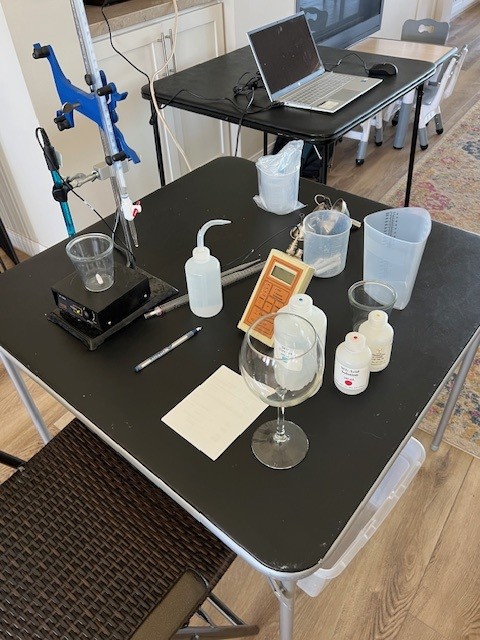
The sugar content of the sample grapes can be measured using either a Brix hydrometer
or a refractometer. Both instruments are usually calibrated at 68 degrees and
the accuracy of either instrument is temperature dependent. However, some refractometers
are temperature compensated and the compensation reduces the temperature error
considerably.
A refractometer can accurately measure the sugar content of a drop of juice. A good temperature compensated instrument will cost about $250 and it can be read directly to 0.2 Brix. A non-compensated refractometer will cost about $100. But, the temperature error can be large and must be taken into account when using a non-compensated instrument. The major advantage to a refractometer is its ability to quickly measure a very small size sample.
A short-range (16 to 25 Brix) hydrometer floated in a small cylinder requires 100 to 200 milliliters of juice. It will cost about $25 and it can be read to 0.1 Brix. The major advantage of a hydrometer is its low cost.
Readings from a good hydrometer are more precise than those from a hand held
refractometer. But, the hydrometer must be used at its calibration temperature
or a temperature correction must be applied to the reading. A simple way of
making an accurate measurement is to make sure both the grapes and the measurement
instrument are at or near the calibration temperature. Then, no temperature
correction is needed.
| TEMPERATURE | CORRECTION |
| 56 | -0.38 |
| 58 | -0.32 |
| 60 | -0.26 |
| 62 | 0.20 |
| 64 | -0.14 |
| 66 | -0.08 |
| 68 | 0.0 |
| 70 | +0.07 |
| 72 | +0.14 |
| 74 | +0.22 |
| 76 | +0.30 |
| 78 | +0.38 |
| 80 | +0.46 |
| 82 | +0.54 |
| 84 | +0.62 |
| 86 | +0.71 |
| 88 | +0.80 |
Sugar Measurement Procedure
The following measurement procedure assumes the sugar measurement is made with
a Brix hydrometer. However, the procedure works equally well with a refractometer.
1. Remove the air from baggy, seal it tightly, lay on a smooth surface and
use a flat-bottomed glass tumbler to lightly crush the grapes in the baggy.
If you crush to hard, the seeds will puncture the baggy and cause leaks.
2. Squeeze the mass of grapes in the baggy several times with your right hand.
3. Unseal the baggy, hold the lip of the baggy over the hydrometer cylinder
with your left hand and carefully squeeze the juice out with your right hand.
With a little practice you can keep the seeds, skins and pulp in the baggy.
4. When enough juice has been collected, carefully lower the hydrometer into
the cylinder.
5. Wait a minute or two to let the hydrometer settle, then tap the cylinder
a few times to make sure the hydrometer is not "stuck" to the side
of the cylinder. 6. Read the hydrometer and record the value.
7. Remove the hydrometer from the sample, measure the sample temperature with
a thermometer and record the value.
8. Use a hydrometer correction chart and apply the appropriate temperature correction
to the measured value.
Summary
Grape to grape, cluster to cluster and vine to vine variations in sugar content
can amount to several Brix. Consequently, a large sample (100 or more berries)
is necessary to obtain accurate results. Obtaining a uniform sample from the
vines that will be picked is important. If the intent is to pick the first three
rows, then the first three rows should be sampled. If the whole block will be
picked, then the whole block should be sampled. A temperature correction will
usually be necessary when measuring sugar with a hydrometer or a non-compensated
refractometer.