The material in this paper is a compilation of information from U.C. Davis , Ohio State University, Oregon State, Cornell University, U.S. and Australian publications (Coombe & Dry, Viticulture Volume 2 Practices) , various internet web sites and personal experience.
WHAT IS GRAFTING
A shoot or bud of one plant or tree inserted into the stem or trunk of another, where it continues to grow, becoming a permanent part, scion. Grafting is an asexual process. Unlike vegetables, which can be reproduced by seeds, grapes will not be genetically identical to the cultivar that produced the seeds.
WHY GRAFT
For a grapevine nursery, it is the most expedient and inexpensive method of propagating grape cultivars to be offered for sale to vineyard developers. The nursery uses a machine to make a matching graft cut in the rootstock and cultivar.
The grafting techniques described in this paper are those generally used in the field. The reasons for grafting are generally either disease, market or site based. Disease can cause the plant to die from the apical portion back toward the trunk - if caught early, a graft on to the healthy part of the vine can save the vine and avoid replanting the vineyard. Market forces can persuade a grower to change from one cultivar to another for economic rewards. Site factors such as microclimate and soil can be the cause for a change of cultivar to remedy a vine selection mistake.
Conversion of a vineyard to a different variety usually can be accomplished in one season. The quick resumption of fruit production is a major advantage of the technique, enabling the vineyard manager to respond to shifting market demands or correct a mistake in the initial selection of the fruiting variety
VINEYARD CANDIDATE
Vineyards that are candidates for field grafting should have all of the following characteristics:
-Fruiting variety is uneconomical to grow or is inappropriate for the site.
-Vines have healthy growth and are relatively vigorous.
-Vines are not infected with crown gall or serious viruses (i.e., leaf roll,
fan leaf).
-Vines are growing on phylloxera resistant rootstock.
-Rootstock variety is appropriate for the site and the new fruiting variety.
-Vines are relatively young with many productive years remaining.
-Row and vine spacing is desirable and appropriate.
-Trellis system is in good condition.
COSTS
Hiring an experienced grafting crew is estimated to cost approximately $1.50
per vine. Additional costs are incurred for collecting or purchasing the scion
wood, and performing pre-grafting preparations and post-grafting care procedures.
You can purchase a grafting knife for under $20. However, if you plan to use
the "chip bud" method of grafting and you have several hundred vines
to graft, I would recommend looking into the Omega Grafting Tool that can make
the cuts from the budding sticks. It costs around $70. The grafting tape either
plastic or adhesive types are inexpensive. All grafting equipment can be purchased
from orchard and vineyard supply stores.
SCION SUPPLY
Most commercial nurseries offer certified bud sticks. Foundation Plant Service (FPS) at U.C. Davis also offers bud sticks for sale. If you are looking for cultivars that are unusual and rarely planted in commercial vineyards, the FPS is a good source.
If you are purchasing or taking scion from another vineyard, make sure you verify with your provider the quality, cleanliness, and health status of the mother plants. I recently performed a grafting demonstration at a local vineyard which had obtained the bud sticks prior to my arrival. After I had made several chip bud cuts from the sticks and was in the process of grafting on to the existing vine, I asked where the bud sticks were obtained. I was told the source and having had prior knowledge of the disease issue with that vineyard, I immediately ceased the demonstration, sanitized my equipment with ammonia, and directed the safe disposal of all the grafting wood.
Grafting success is highly dependant upon the quality and size of the scion
wood. Scion should be collected only from healthy plants in a strong section
of the vineyard, exhibiting no stress or disease problems.
Canes that have been well-exposed to sun are preferred, as opposed to shade
canes.
Scion should be collected during the winter months, preferably in January or
February. Avoid taking wood after a "freeze event" to lessen the likelihood
of collecting damaged buds or canes.
The buds should be dormant and well hardened off.
Look for canes that are 5/16" to 9/16" in diameter and round, not flattened on one side.
Cane length can be up to approximately 2 ft. long. Make a flat cut on the bottom end and an angled cut on the top of the cane to help maintain the canes in proper orientation. Proper orientation is dependent on Polarity of the vine - since most vines are apical growth oriented and the Xylem (which is the vines basic plumbing) transports nutrients from the root system up - it has been shown that when grafting insure that the grafting bud is cut so that it is oriented in the direction of the xylem flow.
Keep canes moist and cool during storage. Bundle canes oriented with the tops (angled cuts) together, and wrap in pre-moistened newspaper. Label each bundle with the variety name using a permanent label, and place in a plastic trash bag or other "air-proof" poly bag to prevent moisture loss during storage. Seal the bags and put in cold storage just above freezing (34-36oF).
Canes should only be removed from storage on the day before grafting. Place
bundles (still in their bags) in a shady, cool location to enable a gradual
rise to ambient air temperature.
Take out only enough for one day's worth of grafting, and leave the remainder in storage.
Make only enough scion chip or sticks that will be used in the next hour or two; also place them in distilled water until used.
It is also recommended that the persons handling the graft wood wear plastic gloves to prevent bacteria infection.
WHEN TO GRAFT
This is mainly Site specific. The general Rule is to wait for the vine to come out of dormancy when the xylem is flowing and the cambium becomes active causing the bark to slip. This is applicable for Spring grafting.
PROBLEMS
Some fruiting varieties should not be grafted to other varieties because of
virus disease problems.
If possible, store the grafting wood on the vine until late in the dormant season,
but cut before the buds begin any growth. Remember that the cultivars differ
as to when they bud break.
The buds may swell and show green tissue up to a quarter inch in length. This can lead to a false graft take as it may dry up in a couple of days.
Regardless of how early the grafts are made, only a few buds start in late April. Most begin in May and on up to mid-June. An occasional bud will start even later, sometimes to mid-July. This is site and microclimate dependent.
TYPES OF GRAFTS
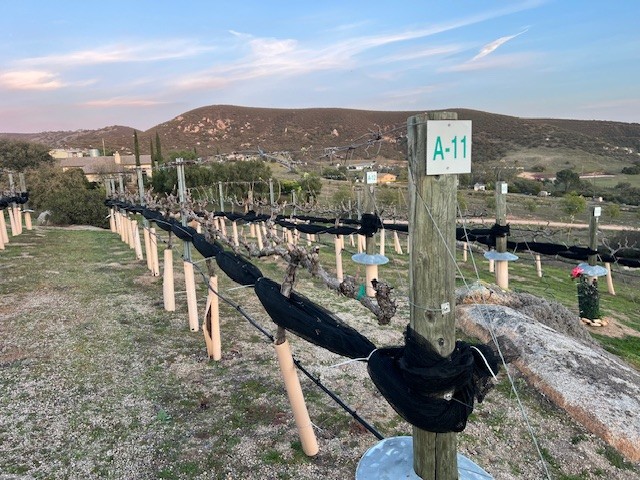
There are several types of grafting techniques. Many large vineyards that are not concerned with the current year's production, will have a crew come in an with a chain saw cut the vine just above the rootstock graft union or at the crown of the trunk. The next crew comes in and prepares two cuts on either side of the trunk with a V-shaped cut at the bottom - they will then take a 2-bud stick and make a long slice cut on one side and a short slice cut on the other side forming a V which will be fitted into the cuts made on the trunk. They then tape and seal the graft area. They will also make one or two slanted cuts into the trunk below the graft to relieve the sap pressure. Other grafts are cleft, notch, whip.
My own experience has decided on the Chip Bud graft as the technique that not only provides the highest success, but, also allows me to gather the harvest from the original cultivar that same year.
CHIP/ T - BUD
I first make a horizontal cut below the scion bud about 1/4 to 1/2 inch down into the wood beneath the bud at an angle of 30° to a depth of inch (3 millimeters) deep Start the second cut about 1/2 to 1 inch above the scion bud, cutting shallowly inwards and downward behind the bud until it intersects the first cut, thus releasing a bud chip
Try to have the chip bud placed on the rootstock within moments from the time you started to make the first cuts. Very few beginning propagators work this quickly while achieving smooth cuts so by placing the chip bud in distilled water will keep it moist. Dehydration of the cut surfaces can also be prevented by budding in a cool shaded area, early or late in the day and on a cloudy, humid day.
Remove the wood chip from the rootstock and replace it with the block-like chip with a scion bud from the bud stick Hold the chip bud carefully between your thumb and forefinger. Do not touch the cut surfaces
The cambium layers of the bud piece must be placed to coincide with that of the stock, preferably on both sides of the stem, Here again insure the Polarity of both the stock and bud is matched.
The poly wrap should be quite firm, stretching the tape almost to the point of breaking. The pressure or tautness of the tying strips must be snug enough to prevent the formation of large pads of undifferentiated rootstock callus (parenchyma cells), between the scion bud (bark) and the rootstock's wood (xylem), which will hold the scion in place but does not form a successful union with the xylem and phloem vascular tissues. Always wrap from the bottom of the bud to the top so that each layer sheds rainwater from the layer below it like a shingle roof.
The T-bud is the same as above except the stock will not remove a chip, but will cut into the cambium a T-shape which will be peeled open to insert the bud stick and then closed and taped.
BIREBENT
The "greffe Birebent" permits the harvest of the current variety, and then the production of the grafted variety the following year. Thus, one can change the variety without sacrificing one year's crop. This technique was developed in France by Birebent.
Based on the principle of the dormant vine, the "greffe Birebent"
is performed after the lignification of the vine, approximately sometime between
August 15 and September 15. The incision made on the based of the vine trunk
is similar to that of the "chip-bud" method; however, in this case,
both the top and the bottom incisions are like that done for the bottom of the
"chip-bud." A dormant bud is then inserted, laterally like a piece
of a puzzle, so that both angles above and below the bud will fit flush into
the vine trunk. Then the entire bud is completely sealed with tape which will
remain intact through the winter, protecting the bud from any harsh exterior
conditions. In the flowing spring, the bud appears swollen beneath the tape,
at which time an incision is carefully made to allow the bud to sprout and continue
to develop
Because the grafting takes place after the vine has ripened, it is easy to obtain the dormant buds of the new variety from other vines possibly already existing in the same vineyard. Even if this is not the case, there is still no need to keep the wood which is to be grafted in cold storage. Furthermore, if the graft does not take on some of the vines, (which could be determined in the spring following the grafting), there is still time to revert to either "T-bud" or "chip-bud" as a second attempt. Thus, it is both more convenient and economical than the traditional methods.
For more information, Birebent can be reached at Worldwide Vineyards, P.O. Box 714, St. Helena, Calif. 94574.
SOURCES
One of U.C. Davis publications is available on the internet: http://cetulare.ucdavis.edu/pubgrape/gv698.htm
Oregon State University has an excellent illustrated guide at: http://berrygrape.orst.edu/fruitgrowing/grapes/graft/graft1.htm
An Illustrated Guide to
Field Grafting Grapevines Michael J. Coe1, Dai Crisp2, and Edward Hellman1
1Oregon State University
North Willamette Research & Extension Center
Ohio State University has many excellent publications regarding vineyard operations; one on grafting is: http://ohioline.osu.edu/b919/0006.html
A superb book on general viticulture is: Coombe & Dry, VITICULTURE VOLUME 2 PRACTICES